
The Myths of Skyros: Achilles, Theseus & King Lykomedes
The great myths of Skyros, where Achilles was hidden dressed as a girl at the court of King Lykomedes, and where the hero Theseus met his death. The stories, and where they touch the island.
Last updated 29 June 2026
For an island this quiet, Skyros carries an outsized weight of myth. Two of the greatest figures of Greek legend, Achilles and Theseus, have their stories bound to this rock, and both threads run through the court of one king: Lykomedes of Skyros.
In short: In myth, Skyros was ruled by King Lykomedes. It is where the sea-goddess Thetis hid her son Achilles, disguised as a girl among the king’s daughters, to keep him from the Trojan War, until Odysseus tricked him into revealing himself. It is also where the Athenian hero Theseus died, thrown from a cliff. Centuries later the Athenian general Cimon conquered Skyros (around 476 BC) and carried what he believed were Theseus’s bones back to Athens.
The court of King Lykomedes
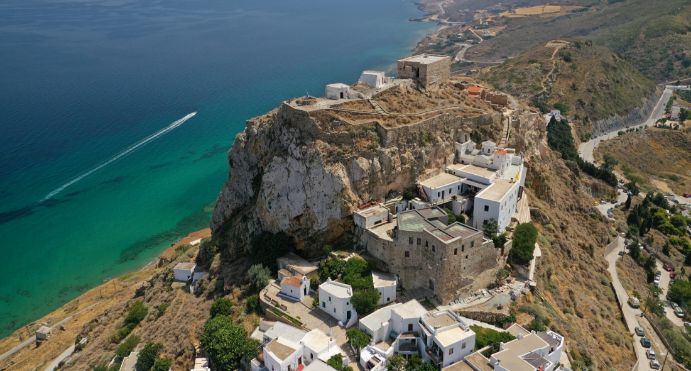
In the old stories, Skyros belonged to Lykomedes, its king, whose citadel legend places on the high rock now crowned by the Byzantine castle above Chora. It is to this court that both great myths lead, first a hero hidden, then a hero killed.
Achilles, hidden as a girl
Warned by prophecy that her son would die gloriously at Troy, the sea-goddess Thetis tried to cheat fate. She brought the young Achilles to Skyros and hid him at the court of Lykomedes, dressed as a maiden and raised among the king’s daughters. There he fell in love with the princess Deidamia, and they had a son, Neoptolemus, who would later fight at Troy in his father’s place.
The disguise could not last. The Greeks, told they could not win the war without Achilles, sent Odysseus to find him. Odysseus came to the palace as a merchant and spread out gifts before the women: jewellery and fine cloth, and, among them, a sword and shield. When a war-trumpet suddenly sounded, one “girl” reached for the weapons by instinct. Achilles was revealed, and he sailed for Troy, and his fate.
Theseus, thrown from the cliff
The second myth is darker. Theseus, the great king and hero of Athens, slayer of the Minotaur, was in his old age driven out of his own city. He retired to Skyros, where Lykomedes at first received him as a guest. But the king, so the story goes, led him to the edge of a high cliff and treacherously pushed him to his death on the rocks below. So the hero of Athens died, an exile, on this small Aegean island.
Cimon and the bones of Theseus
The myth has a striking historical coda. In the early 5th century BC, an oracle told the Athenians to recover the bones of Theseus. Around 476 BC, the Athenian general Cimon conquered Skyros, then held by Dolopian pirates, and unearthed what he took to be the hero’s remains. He carried them back to Athens in triumph, where they were enshrined in a sanctuary, the Theseion. Myth and history meet here: an Athenian fleet, a legendary grave, and a small island suddenly at the centre of the Greek world.
Where the myths touch the island
You won’t find labelled “myth sites” on Skyros, and that is part of the charm. But standing on the castle rock above Chora, with the whole island and the sea below, it is easy to see why the ancients set a king’s citadel here, and why they imagined both a hidden hero and a fallen one on these heights. For the island’s real, dug-up antiquity, visit the Bronze Age town at Palamari, and for the fuller timeline see our short history of Skyros.
FAQ
Why was Achilles hidden on Skyros? His mother Thetis, knowing he was fated to die at Troy, disguised him as a girl at the court of King Lykomedes to keep him from the war. Odysseus later tricked him into revealing himself.
How did Theseus die on Skyros? In myth, the Athenian hero, exiled from his city, was received by King Lykomedes and then treacherously thrown from a cliff on the island to his death.
What is the connection between Cimon, Skyros and Theseus? Around 476 BC the Athenian general Cimon conquered Skyros and recovered what were believed to be Theseus’s bones, carrying them back to Athens to be enshrined in the Theseion.
Part of Chora & Culture. Want the island’s history woven into your visit? Plan your trip →